| |
|
|
PARALLEL
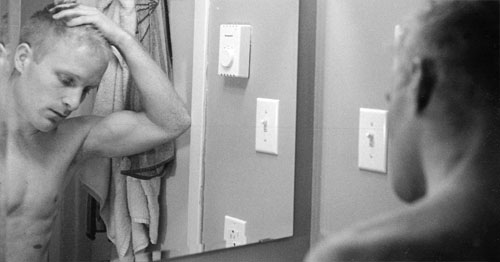
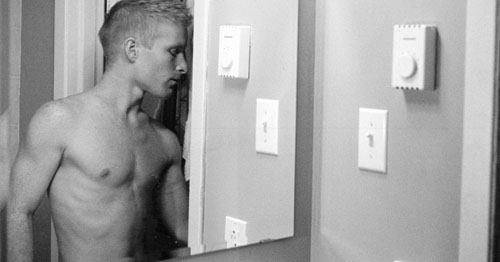
images from Exit
Owen Eric Wood (2004)
|
Artist Statement
Parallel
An Interdisciplinary Art Project
by Owen Eric Wood
Parallel is a video not just about me but specifically me as an artist. It is a personal journey to find meaning in the act of creation, to understand the reason why I do what I do, what affect it has on me, and how this process feeds back on itself, creating a self-perpetuating cycle of emotional expression and reaction. Perhaps you have asked yourself, do I listen to to sad music because I feel sad? Or do I feel sad because I listen to sad music? This is the general idea behind Parallel.
Work on this project began in 2004 with a photography project I call Exit, which consists of a series of 12 self portraits depicting loneliness and isolation. As the series progresses, these feelings are emphasized when I leave each scene of each image and the notions of loneliness and isolation become more pronounced with the empty spaces left behind. This project expressed how I felt at the time, feelings that were no doubt a result of both moving to a new city away from everyone I knew and having to deal with a number of personal issues on my own.
When I presented Exit to my class, another student presented a project that dealt with similar subject matter. However, instead of seeing loneliness in a dark and depressing vain, he viewed it in a positive light. For him, being alone was an opportunity to get away from the distractions and pressures of people and be free to his own thoughts for the first time in his life. It struck me that two people could have very different perspectives in the face of a shared experience. For the first time, I considered the power of perspective over one's perception of reality. How I perceive the world can influence my experience of it often more so than how the world actually is.
As I considered the concept of creative feedback, I asked myself a series of critical questions. Had I created images of loneliness and isolation as an expression of my feelings? Or was I feeling lonely and isolated because these were the images I had created of myself? Had the images strengthened feelings that were already there, which would then feed back into the future art works I would create? If I was indeed inside such a cycle, could the cycle be broken? Could I take control of it? What if I created a project about loneliness and isolation, but consciously attached a positive spin to it?
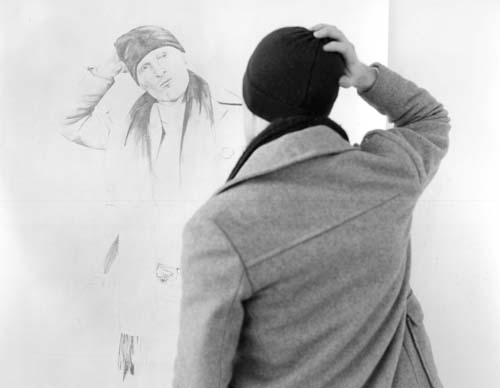
image from Two
Owen Eric Wood (2005)
|
This last question lead to my second photography project, titled Two, a series of 22 self portraits that merge black-and-white photography with photo-realistic pencil drawings. The relationship between the drawn and photographic elements creates interactions between the constructed representations of myself. They play off each other, creating a paradox in which I am alone yet there is a sense that someone else is present.
The images of Two became the direct source for the visual treatment of my video Parallel. My interest lies in exploring the changes that occur when a project is translated from one artistic discipline to another. In this case, recreating drawings and photographs into video meant adding the elements of time, movement and sound, which did not exist in Two. I replicated the imagery by dressing up in the same costume and returning to the original locations where the photographs were shot, this time reshooting the scenes with a video camera.
Then I hit a wall. In translating my photography and drawing project into video, I came to realize the project needed a literal narration to accompany the visuals. Adding text to pictures is always a tricky matter in art. Redundancy is the enemy. The pictures cannot simply be an illustration of the text, nor can the text merely be an explanation of the images. Each much be treated with respect as a distinct creative discipline, bringing to the project a unique layer of context, and yet they must work together in interdisciplinary unison in such a way that the relation between them in unquestionable. Both text and image must hold equal weight.
I tried to express the project in words. I had the ability to talk about Parallel but this was a conversation best suited to external discussions of the project, not within the project itself. The images speaks of interdisciplinary communication and does so better than I can myself. After major revisions that saw the entire script scrapped for a completely fresh start, I was still at a loss.
It was about that time I had a chance encounter. It was February 2008 and I was in Copenhagen visiting my friends Shanti and Anders. Since Shanti had just given birth to their first child, her parents were also visiting. When I showed Lois and Kuruvila Zachariah images of Two, they began talking to me about it not in terms of its artistic value but in terms of their field of expertise — physics. I was overwhelmed with excitment. I was already interested in cross-disciplinary studies, but I hadn't extended my work to far reaches of science.
Kuruvila spoke of the theory that the human consciousness has a direct impact on the physical world. He explained how many physicists believe our thoughts affect the behaviour of subatomic particles, how the universe, in essence, rearranges itself in reaction to the mind's will. He interpreted my images as a depiction of this concept. By taking a self portrait standing infront of a drawing of myself references the connection between thought and creation, how one feeds into the other and back again, creating a loop so endless it becomes unclear which came first. Do my thoughts determine what I create, or does the experience I receive from my creation determine my thoughts?
He recommended I read The Dancing Wu Li Masters by Gary Zukav, a book that explains the complex issues of quantum physics in words that non-physicists can understand. Zukav's book is not only brilliant in the way it makes quantum physics comprehensible; it is also a book that transcends disciplinary boundaries by making connections between subjects traditionally seen as having absolutely nothing in common. This was the magic in the Zachariahs' interpretation of my work. They are not artists yet they read my images as if they were well versed in the the visual vocabulary of fine arts, as if my images were mathematical equations. And they understood what they saw so well, they taught me something about my work that I didn't know.
From an interdisciplinary viewpoint, Gary Zukav's words are revolutionary. Not only does he say the physicists of the 20th Century were actually philosophers, but he finds links between scientists and artists.
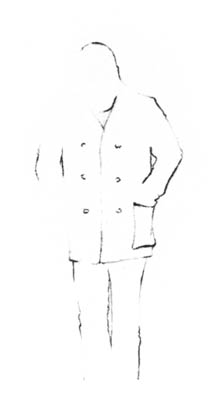
image from Two
Owen Eric Wood (2005)
|
"...the distinction between scientists, poets, painters and writers is not clear. In fact, it is possible that scientists, poets, painters and writers are all members of the same family of people whose gift it is by nature to take those things which we call commonplace and to re-present them to us in such ways that our self-imposed limitations are expanded." (Zukav, 36)
Zukav's book became the platform my narrative needed. Although his comparisons between art and science are scarce, reinterpreting his ideas in the context of art, I found far more connections than what lies on the surface. Developing a script for Parallel from a source outside of drawing, photography and video, indeed outside of art altogether, was a perfect way to ensure the balance between text and image. Although distinct in form, the philosophical dilemmas in the Dancing Wu Li Masters are fundamentally the same as the questions raised in Parallel.
Zukav writes, "...it is no longer evident whether scientists really discover new things or whether they create them. Many people believe that 'discovery' is actually an act of creation." (Zukav, 36) Zukav is referring to experients in particle physics that show how the mere presence of the observer (i.e. the scientists themselves) affects the behaviour of subatomic particles to the extent that they have no idea if the results would be the same if they, the scientists, were not looking for the results. In fact, he says, they are not only most likely not to be the same, but that physicists are in the position that they must consider the possibility that the particles themselves may not have even existed if the scientists hadn't decided to do an experiement on them.
To illustrate, Zukav explains that in the case of measuring the momentum of a particle, or its change of position over time, it is impossible to "know both the position and the momentum of a particle with absolute precision... we must choose which of these two properties we want to determine. Metaphysically, this is very close to saying that we create certain properties because we choose to measure these properties. Said another way, it is possible that we create something that has position, for example, like a particle, because we are intent on determining position and it is impossible to determine position without having some thing occupying the position that we want to determmine." (Zukav, 52-54)
As Zukav asks, "did a particle with position exist before we conducted an experiment to measure its position?" (Zukav, 54) I find myself asking, did my emotional state exist before I decided to express it through art? Having explored issues of loneliness, isolation and alienation in a number of art projects, I was beginning to question the legitimacy of my feelings. Although I recognize an original source for those emotions, I was unsure if their continued presence was a response to my life, or if they were being maintained, perhaps even enhanced, by the act of expressing them in physical form — the images I create — and then repeatedly exposing myself to these images.
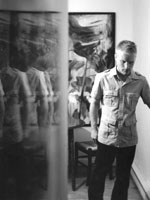
image from Exit
Owen Eric Wood (2004)
|
One of the main differences between the old physics and the new physics (Newtonian physics vs. quantum mechanics) is that in the old physics everything follows the laws of gravity, attraction, etc. while the new physics acknowledges the existence of things smaller than atoms, and that these things — subatomic particles — do not appear to follow the laws of physics. The problem is that everything is made of subatomic particles, which implies the laws of physics are practically useless. More curious, despite their apparent defiance of physical laws, subatomic particles seem to react to the human mind as if they listen to our thoughts. But since our brains are also made of these subatomic particles, are we in control of them or are they in control of us?
If I made images of loneliness because I was alone, to what extent was my state of loneliness my own doing? More important, if the human mind has the power to influence the behaviour of subatomic particles, and thus have the power to change the physical world, could I take control of the relationship between myself and my art and rewrite my story? Instead of allowing myself to becoming a passive victim of my own emotional state, could I take an active role by applying a positive, creative and inspiring approach to my creation and thus my physical state?
Just as the title Two refers to the coming together of two artistic disciplines, the title Parallel is a reference to the various connections discovered during the course of this project — between the various artistic disciplines used, between my personal life and universal contexts, between science and art. Parallel acknowledes the difference between reality and one's perspective of reality, how our perspection is often more powerful than the reality of any given situation. In the face of life's many challenges, the solution is often found not changing the physical world, but in changing one's persepective of it. In recognizing the internal machine I was caught within, I now find myself standing as outside observer. I still have a relationship with this machine, but I'm uncertain how our relationship has changed. Is it now reacting to my mere presence as witness? Am I being affected by looking in? Who is in control?
"Philosophically... the implications of quantum mechanics are psychedelic. Not only do we influence our reality, but, in some degree, we actually create it." (Zukav, 54)
|
|
